CZIVIO
The Wikipedia Enthusiast Communication Group ( Telegram : @wikipedia_zh_n , IRC : #wikipedia-en link , both connected) welcome everyone to join.
| [ Close ] |
Shinjuku Imperial Court [ edit ]

| Shinjuku Imperial Court | |
|---|---|
 | |
| Garden Information | |
| area | Shinjuku and Shibuya, Tokyo, Japan |
| area | 58.3 hectares |
| Open House Day | May 1906 |
| Manager | Ministry of the Environment Shinjuku Imperial Court Management Office |
| address | The 11th place of Fuji-machi, Shinjuku-ku, Tokyo |
| Postal code | 〒160-0014 |
| telephone number | (+81) 03-3350-0151 |
| Homepage | Official website |
| Japanese writing | |
|---|---|
| Japanese original | Shinjuku Imperial Court |
| pseudonym | しんじゅくぎょえん |
| Plain Roman type | Shinjuku Gyoen |
Shinjuku Gyoen National Garden is a garden that spans Shinjuku and Shibuya in Tokyo, Japan . It has an area of 58.3 hectares. In the Edo period, it was the home of the Naito family . Later, it became a court managed by the Miyauchi Office and is now a national park under the jurisdiction of the Ministry of the Environment .
table of Contents
[ hide ]- 1Garden History
- 2components
- 3surrounding stations
- 4admission information
- 5References
- 6related projects
- 7External links
Garden History [ edit ]
The Shinjuku Imperial Court site was originally awarded as a part of the residential land of Kazuyuki Naito , when Kazuya Ishikawa entered the city of Edo in the 18th year of Tengen (1590) . The land east and Yotsuya , west Yoyogi , South Sendagaya , north to Okubo , was the guardian of the Edo west of Koshu Street , Plum Street and Kamakura street intersection point of strategic importance. Tokugawa Ieyasu was awarded a reliable minister for military purposes. Lu Yuan for four years (1691), Naito home seventh generation master of the house Naito becomes clear pieces of Shinshu lofty city primary, due to the homestead cost far more than their income and, therefore, part of the land back to the Edo shogunate . As of the 5th year of Meiji (1872), the remaining land was still over 33 hectares.
In the Meiji Five Years (1872), the Japanese government established a Naito Shinjuku Test Site ( Naito Shinjuku Test Site) in order to rejuvenate Japan’s modern agricultural technology on the basis of a total of 58.3 hectares of homestead and neighboring land parcels handed over by Naito.けんじょう ). A large number of experiments on fruit trees, vegetable cultivation, sericulture, and animal husbandry were carried out at the test site, including technologies and species from the West. In 1874, the test site was placed under the jurisdiction of the Ministry of Internal Affairs and the Institute of Agronomy was newly established. Meiji years (1877), the Institute transference to Komaba , later renamed the Komaba Agricultural College, today University of Tokyo Faculty of Agriculture predecessor.
In the 12th year of Meiji (1879), the expansion of the new government’s agricultural revitalization policy, some facilities of the test site were relocated elsewhere. In this place , Shinjuku Botanical Garden ( しんじゅくしょくぶつぎょえん ) , which is governed by the province of Miyagi, is established . In the meantime, a duck pond, a fish pond, and a zoo were set up in the garden, and were operated as royal lands and farms of the Japanese imperial family (the zoo was given to the Ueno Zoo during the Taisho fifteenth year (1926) ). At the same time, the area continues to serve as a model farm for research on the cultivation of fruit trees and vegetables. In Japan, greenhouse technology is used to cultivate flowers such as orchids , and it is dedicated to popularizing horticulture introduced from Europe and the United States to the Japanese people.
In the 31st year of Meiji (1898), Fuyu Yiren became the person in charge of the Imperial Court. In the thirty-fourth year of Meiji (1901), the three chrysanthemums planted in the Imperial Garden were exhibited at the World Exposition held in Paris and received great praise. At the same time, Fuyeeyi asked Henri Martine of the Versailles Horticultural School to transform the Imperial Garden into a landscape park. In May of the 39th year of Meiji (1906), the Shinjuku Imperial Court was completed after a four-year renovation. Emperor Meiji attended the opening ceremony of the ceremony and the celebration of the Russo-Japanese War . Although the original design was destroyed in the 1945 air raid, according to Martin's aerial view, the original garden was basically the same as the current one except for individual buildings.
The original Shinjuku Gyoen National Garden serves as a royal courtyard, and at the same time provides Tokyo with street tree branches cuttings and seeds. In addition, since the Taisho Sixth Year (1917) and the Showa Four Years (1929), the Imperial Garden has become a fixed place for the viewing of cherry blossoms and the Guanju Club. In addition, during the Daejon period, a 9-hole golf course was built on the basis of a Western-style garden. However, in May of the 20th year (1945), the construction of the garden was almost completely destroyed in the air raid. After the war, the garden was once the seat of the high school of the Tokyo Metropolitan Agricultural Science Institute.
In the 22nd year of Showa (1947), the Japanese cabinet decided to run Shinjuku Gyoen National Park together with Imperial Court and Kyoto Gyoen National Park. On May 21, 1949, the garden was officially opened to the public as the National Park Shinjuku Imperial Court ( こくみんこうえんしんじゅくぎょえん ) and moved to the Ministry of Health and Welfare the following year . After that, with the establishment of the Environment Office in July of 1971 (1971) , Shinjuku Gyoen National Garden moved to the Environment Agency together with other national parks. After re-editing by the Central Government Office in January of 2001 (2001) , the management authority was transferred to the Ministry of the Environment . [1]
Components [ edit ]
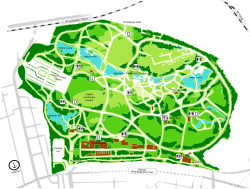

- Entrances and exits: In addition to the locked main entrance, the Imperial Court has three entrances, namely the Shinjuku Gate, the large wooden gate, and the Millennium Gate. Among them, the old Shinjuku Gatehouse and the old large wooden gatehouse are buildings of the Showa era.
- Japanese gardens: The gardens were developed around the Nagoba pond built by Naito’s homestead. Old Queen's Park pavilion ( the old Royal pavilion ), also known as Taiwan Pavilion , built in Showa years (1927), was in Taiwan to congratulate the Japanese Emperor Showa married donated, is currently in Tokyo selected historical buildings. [2]
- English landscaped gardens: The park's old Imperial House Imperial Rest Quarters ( Oishi Museum Imperial Rest House ) was a Western-style wooden building built in the year of the Meiji Ninety-Eighth (1896). It was designated as Japan in 2001 (2001). National important cultural property. [3]
- Greenhouse: The large-scale greenhouse in the park was originally completed in 1983 (Showa 33); it was closed due to the expansion and expansion of the greenhouse from May 13, 2007 (2007), and is currently planned for 24 hours. The year (2012) reopened in autumn.
- French-style plastic garden
- Mother and child forest
Nearby stations [ edit ]
- ○ Marunouchi Line-Shinjuku Gyoenmae Station(Shinjuku Gate, Omuchimen)
- ○ Toei Shinjuku Line-Shinjuku Sanchome Station(Shinjuku Gate)
- JR · Keio · Odakyu Line - Shinjuku Station South Exit (Shinjuku Gate)
- Seibu Shinjuku Line - Seibu Shinjuku Station (Shinjuku Gate)
- ■ Central ・ Sobu Line - Millennium Station (Thousand Valley Gate)
- ○ Toei Oedo Line-National Arena Station(Thousand Miles Gate)
Admission information [ edit ]
- Admission time : 9:00-16:00 (closed at 16:30)
- Park Day : Monday (Monday is the day of the feast day is changed to the next day) and the end of the year
- Admission fee : 200 yen for adults, 50 yen for elementary and middle school students, and free for young children
References [ edit ]
- ^ The background of construction and history Ministry of the Environment. [ 2009-11-02 ] (Japanese) .
- ^ Both selected historical monuments Metropolitan Urban Development Bureau of Tokyo Metropolitan Government. [ 2009-11-02 ] (Japanese) .
- ^ Shinjuku Gyoen Old Ocean Museum Imperial Rest House . Modern architecture. [ 2009-11-02 ] (Japanese) .
Related Projects [ edit ]
- Fuyu Yiren
- French style garden
- Tokyo Metropolitan Area
- Garden of Words
- 5 centimeters per second
External links [ edit ]
 | Related Multimedia Resourcesin Wikimedia Commons :Shinjuku Imperial Court |
- Shinjuku Imperial Court (Japanese)
7 categories :
- Tokyo Metropolitan Park
- Japanese Garden
- Japanese Imperial Garden
- 100 cherry blossoms in Japan
- Shinjuku City
- Shibuya
- Gao Yuanyu


